


The witness was trying to express the impossibility of saying no to Alan Jones. Anguished, Complainant C testified that he regretted every day that he “didn’t fight back or say ‘no’ louder, but you couldn’t”.
“Alan was protected, he was the golden goose,” he told the court. “There was no way in the world I could have said anything to anyone.”
Complainant C was the second man to testify in Jones’ trial this month on 22 counts of indecent assault and sexual touching, charges Jones vehemently denies.
The first prosecution witness, Complainant J, also gave evidence of the enormous power – perceived or real – that Jones wielded at the height of his broadcasting career.
The former star athlete told the court that when Jones grabbed his penis while he was driving, he struggled to maintain control of the vehicle.
“I had one of the most powerful men in the country in the car and I had to focus on the road,” he said.
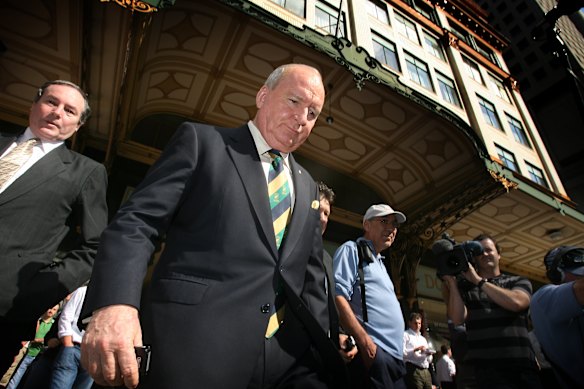
This characterisation – Jones as one of the most powerful men in the country – is difficult to conjure as the 85-year-old sits in the courtroom a much-diminished figure, flanked by lawyers but with no personal supporters or family; meticulously dressed but walking with the aid of a cane.
Jones used to command the bully pulpit of the ratings-busting 2GB breakfast slot, an enormously influential post in the pre-internet age, when media was concentrated and the loudest voices commanded the biggest audiences.
Now he is silent as the evidence is led, much of it highly intimate and shaming.
Journalist Chris Masters, who wrote the definitive Alan Jones biography Jonestown, published in 2006, says he remembers sitting down with Jones once “and observing to him that he was more powerful than a premier or a prime minister”.
“His reaction was that he was really proud of that,” Masters recounts. “Philosophically, that puts him at odds with other people in the media. In the media we don’t seek to control the outcome.”
Jones’ prodigious energy – he famously only sleeps a few hours a night – combined with his enormous listenership and his lobbying power in business and politics meant that he could seek to control outcomes.
And he did.
Jones started on 2UE radio in 1985, and in 1988 he moved to his signature breakfast time slot, from 5.30am to 9am.
In the mid-1990s his audience share was 22 per cent, which was the largest radio share in Sydney and one of the largest, if not the largest, in Australia.
In 2019 it was reported he had enjoyed 218 ratings survey wins.
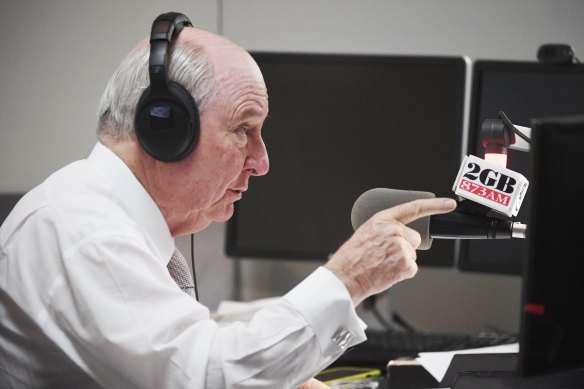
In 2002 he moved to 2GB and, while his audience share dwindled slightly over time, he remained there until 2020 – his last annual contract was reportedly for $4 million.
For more than three decades Jones barraged his listeners with opinions about racing policy and the arts, about town planning, economics and tax; about casino licences and criminal cases he took up.
Some of his opinions were famously paid for – as the “cash for comment” scandal of 1999 laid bare.
But most of Jones’ opinions were genuinely, and vociferously, held. They resulted in multiple defamation payments, which his employer copped.
Jones famously had a “pick-n-stick” club of cronies on whom he lavished great largesse, and from whom he expected total loyalty in return.
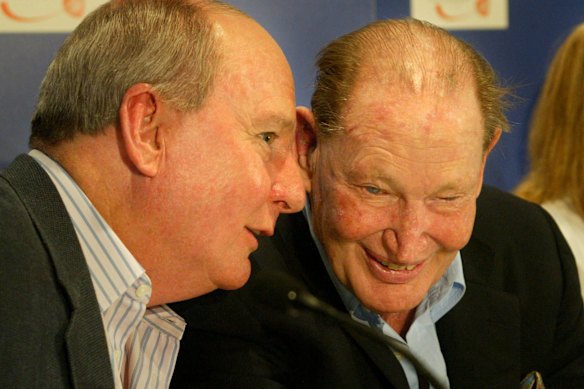
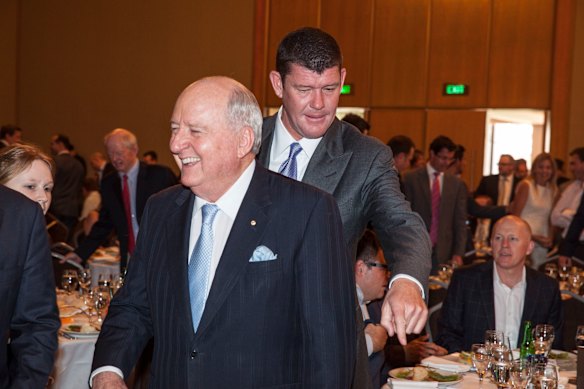
He was friendly with a huge variety of politicians and sportspeople, and had long-standing close relationships with powerful men such as Kerry and James Packer, Liberal party powerbroker Michael Kroger, colourful financier Rene Rivkin, Graham Richardson and the powerful media agent Harry M. Miller.
As journalist David Leser wrote in a profile of Jones published in Good Weekend in 1998: “Jones’ is a world of credits and debits, a world of payback. You get credits for gratitude and loyalty, and debits for what he perceives to be an absence of same.”
Often, Jones thought he knew better than the courts. He advocated fiercely for people who he believed, often with little evidence, had been locked up unfairly.
His advocacy for Kathleen Folbigg, who was convicted in 2003 of murdering four of her babies, undoubtedly helped raise awareness of her case, leading to two judicial inquiries and her eventual exoneration in 2023.
Sometimes the causes seemed far less worthy, like Jones’ furious lobbying for Manly hotelier Andrew Kalajzich, who in 1986 was convicted of hiring a hitman to kill his wife.
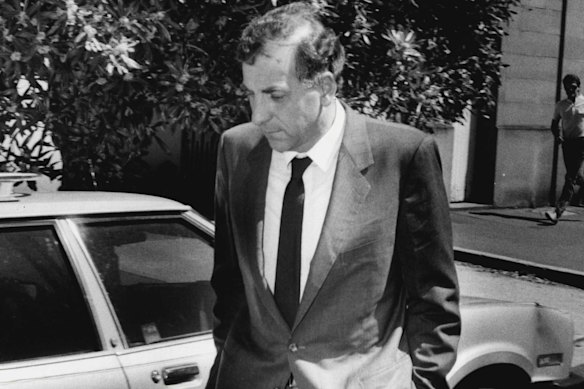
Jones believed there had been a miscarriage of justice, and he used his radio show to assert Kalajzich’s innocence, repeatedly and passionately.
The campaign led to a judicial inquiry into the murderer’s conviction in 1995, conducted by retired Supreme Court judge John Slattery, QC, which re-affirmed Kalajzich’s guilt with “no doubts or questions”.
Another of Jones’ pet causes – his 2018 campaign against the Queensland Wagner family, claiming they were responsible for 12 deaths in the 2011 Lockyer Valley floods, cost Jones and 2GB $3.7 million in damages.
Jones intervened in matters high as well as low – literally, when it came to Sydney’s Crown Casino tower.
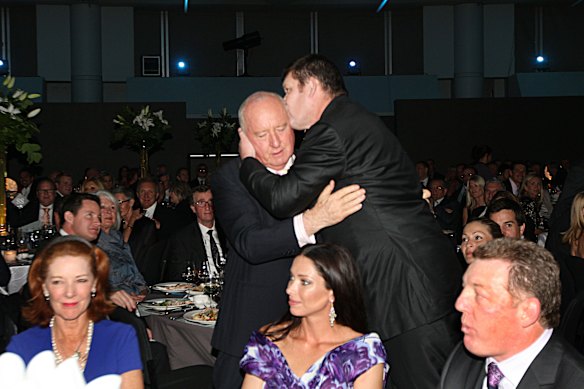
In February 2012, Jones brought together billionaire James Packer and then-NSW premier Barry O’Farrell for a cosy lunch at his luxury Sydney apartment in the “Toaster” building at Circular Quay.
Packer “had this vision for Sydney”, as Jones later put it. He wanted to build a luxury hotel and a casino in an enormous tower at Sydney’s Barangaroo.
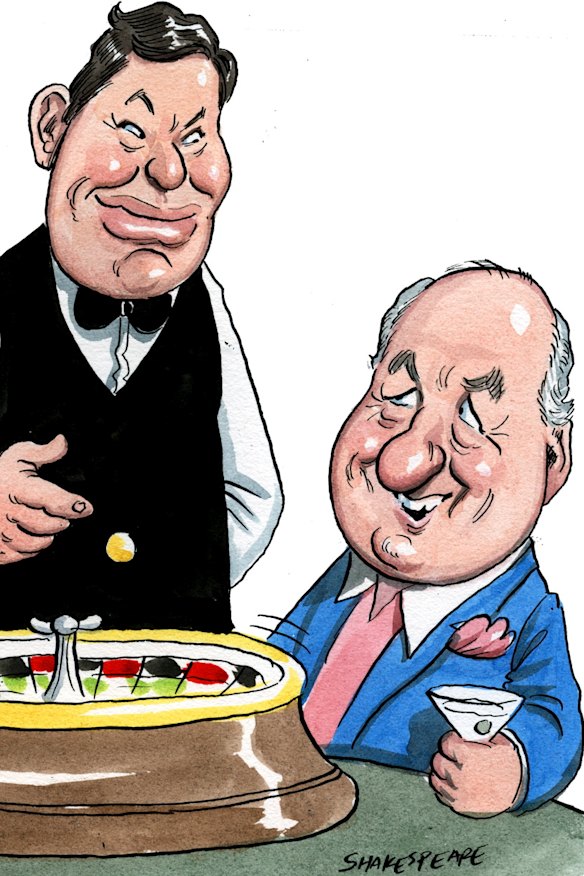
A few weeks after that meeting, Packer was interviewed on Jones’ show. “Barry O’Farrell is quoted today as saying he embraces the plans for a hotel and second casino at Barangaroo,” Jones told his billionaire guest, and asked him a question to which he already knew the answer: “Have you spoken to him about this?”
O’Farrell did not respond to attempts to contact him for this story.
Chris Sidoti, then the chairman of the NSW casino regulator, later told ABC’s Four Corners that the casino proposal had “momentum”.
“Having had James Packer behind it and knowing his powerful friends, it seemed to me at the time that this was going to happen.”
There was no tender process, and construction on the casino site began in 2016.
In 2021 the NSW regulator ruled Packer’s Crown Resorts was unsuitable to hold a casino licence. It is now controlled by the Blackstone Group.
Andrew Meares
This secret meeting – which was not disclosed by either O’Farrell or Packer – highlights what was perceived to be Jones’ most notorious power: his influence over politicians.
“He’s a failed political candidate himself,” Masters says of Jones. “But he managed to find the bully pulpit where he dictated politics.”
Masters says politicians both federal and state were “astonishingly frightened” of Jones, and would regularly do the “walk of shame” to Jones’ show, with NSW premiers, in particular, convinced they needed him to maintain their own power.
“They went on his show not out of respect but out of fear,” Masters says. “They were concerned about that short-term loss if there was an election or a byelection coming up. They didn’t see any benefit in taking him on, on air, and fighting him.”
But Masters believes politicians’ fear of Jones was misplaced, that they gave him power by appearing on his show, often to be berated or lectured.
Despite his huge audience, Jones’ power was limited – by his Sydney-centric listenership and by the fact that his listeners were overwhelmingly older, rusted-on conservatives unlikely to change their vote.
Along with, famously, Malcolm Turnbull, one federal politician who did take Jones on was former Howard government cabinet minister Amanda Vanstone, who, Jones once said, “couldn’t run a pigsty”.
As Vanstone tells it, the trouble began during one interview in 1995, when she alluded to Jones’ 1988 arrest in a London toilet, following which he was charged with “outraging public decency” and “committing an indecent act”.
The charges, which Jones vigorously denied, were dropped by police, but for years his enemies mocked him with innuendos about the matter. Just not usually to him, on his radio show.
Vanstone says Jones was hectoring her about a criminal who was about to be released from jail, who Jones believed should stay in jail, when she reminded him about the rule of law.
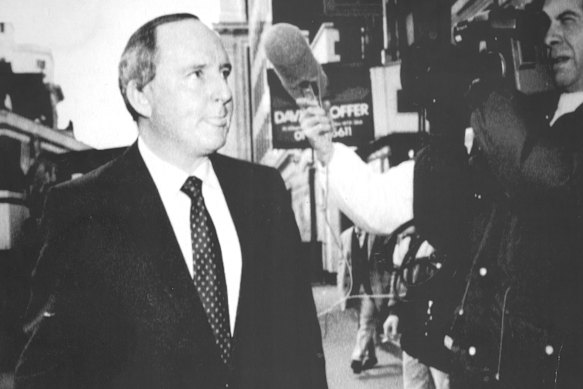
“I said to him: ‘Just say we were overseas in a public place and we got charged with something – it would be a bit different, wouldn’t it?’” Vanstone recalls. “That encounter started 10 years of constant negativity towards me on air.”
She found out years later that he wrote repeatedly to prime minister John Howard, telling him he should sack her as a minister.
Vanstone recalls Howard ringing her about her rift with Jones and asking, “was there a possibility we can make this better?”
Vanstone told Howard that no, she didn’t think so, and Howard dropped the matter.
The former immigration minister sees this episode as “confirmation [Howard] was not doing Alan Jones’ bidding”.
“Jones might have had close contact and been able to express his view to Howard in a way that others didn’t, but that’s no indication that Howard listened to him or followed him up.”
Says Howard: “I vaguely remember that, and it sounds right.”
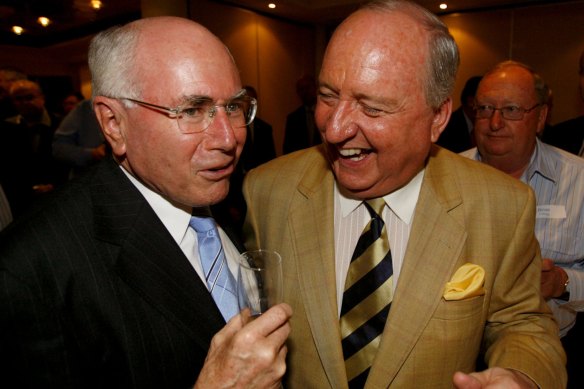
“Alan was very opinionated … but I would not have taken any notice of him about whether to keep or discharge a minister,” the former prime minister says.
“He had my ear, I listened to what he had to say because we were friendly, but I wouldn’t do his bidding.”
Howard, who is now 87, says Jones was a strong supporter of his from the time he became opposition leader in 1985, the same year Jones joined 2UE as the morning show host.
“I didn’t have many journos who were [supportive] and I didn’t forget that,” Howard says. “On the other hand, he could be difficult about certain issues.”
Howard says Jones “used to give me carry-on” on pet topics, including tariffs (Jones was in favour of them) and the duopoly of Coles and Woolworths. “But when the crunch came he would always speak in favour of the return of my government.”
Howard rejects historic reports that he had a “minister for Alan Jones” in his office staff (rumoured to be David Elliott, who later went on to serve as NSW police minister).
“[Jones] was a prolific letter writer and there was somebody in my office who used to deal with it, and with other things as well,” Howard says. “He was an influential broadcaster and I used radio a lot to get my message across.”
Now, Howard says, Jones “remains a friend”.
“Both my wife and I have continued to be in touch,” he says.
Bob Carr served as NSW premier from 1995 to 2005, and later became foreign minister under prime minister Julia Gillard, serving 18 months in that role until September 2013. “He could be a fierce and effective ombudsman,” Carr says of Jones.
Carr says that Jones had an “enormous capacity” to take up causes and pursue them on air, and that he spoke to his cabinet about Jones, telling them not to dismiss the broadcaster’s hobbyhorse issues. “Sometimes it was useful for ministers to examine what he was saying and see where their departments might be letting them down,” Carr says.
On the other hand, says the former premier, Jones “would take up causes put to him by whistleblowers, and direct a monstrous fury at some innocent public sector manager who thought they were only doing their job”.
Carr freely admits that Jones “did berate me on air” but “I thought it better to front up and defend my policies”.
When the former premier was out campaigning, people would often say to him, “I heard you on Alan Jones.”
“That’s why I kept turning up. He had large audiences … he had given himself, by sheer persistence and diligence and monomanias, something of a status that an editor of a tabloid might have.”
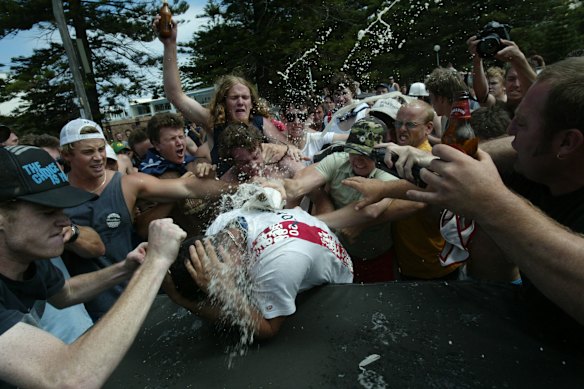
In 2005, months after Carr left the Labor leadership and Morris Iemma became Labor premier, Jones fulminated on radio over racial tensions in Cronulla, in Sydney’s south.
Jones’ power was such that he was later found to have encouraged the brutality of the ensuing Cronulla riots, using his program to suggest that “biker gangs … be present at Cronulla railway station when these Lebanese thugs arrive” and asserting that “we don’t have Anglo-Saxon kids out there raping women in western Sydney”.
He also read out letters and texts from listeners vilifying Lebanese-background Australians.
In 2007, the Australian Communications and Media Authority found that Jones’ employer, 2GB, had breached the Commercial Radio Codes of Practice by broadcasting material likely to encourage brutality.
Jones was not sanctioned, either by the authorities or his employer. “While he was making money, they were more than happy for him to go on,” says Masters. “The factors that counted against him in the end were more organic than regulatory.”
When Sean Kelly, now a columnist for this masthead, was press secretary to prime minister Julia Gillard, Jones was “still a big figure”, he says. Following her announcement of the carbon price in February 2011, Gillard did back-to-back media interviews. When one interview ran over time, she was late to her scheduled appearance on Jones’ 2GB show.
“Alan Jones tore absolute strips off the prime minister of the day for being a little bit late to an interview,” Kelly says. “It is an extraordinary reflection of the contempt in which he held a female prime minister – which was borne out in subsequent events – and a pretty strong reflection of the man’s perception of his own place in the world.”
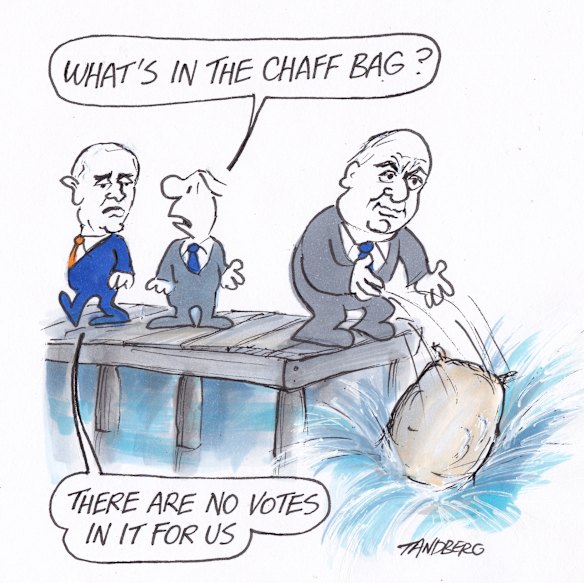
In 2012 Jones’ made now-infamous comments to the Sydney University Liberal Club about Gillard’s father having “died of shame”, a follow-up to an on-air rant in which he said Gillard should be “shoved in a chaff bag” (along with Greens senator Bob Brown and Sydney Lord Mayor Clover Moore) and carried out to sea.
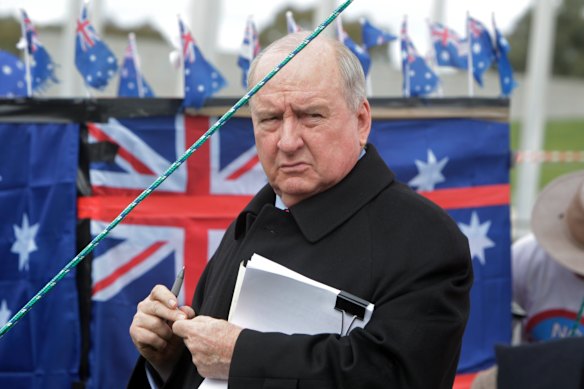
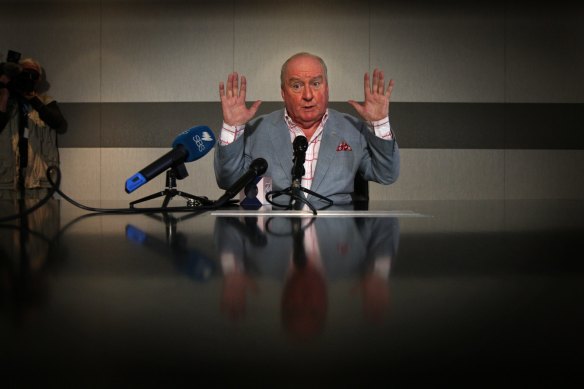
Following publication of the “died of shame” remarks, and a public outcry over them, Jones tried to contact the prime minister to apologise. Gillard declined the opportunity to speak to him.
Despite Jones’ campaign against the woman he called “Juliar”, and his ferocity in tearing down the carbon price, Kelly believes that period in Australian politics was “actually the beginning of people realising that [Jones] didn’t have as much power as he had been perceived to have”.
Jones’ vitriol against Gillard and others, including former Victorian Police commissioner Christine Nixon and former Opera House chief Louise Herron, galvanised feminist forces against Jones. It also sparked a discourse about misogyny in Australian public life.
Feminist activist groups such as Destroy the Joint and, later, Mad F—ing Witches lobbied advertisers, who eventually began to sour on Jones, especially after he told prime minister Scott Morrison, during a 2019 interview, that he should “shove a sock down the throat” of the New Zealand prime minister Jacinda Ardern. Jones also said Ardern should be “backhanded”.
Eventually, the vitriol and wild rhetoric that had kept politicians and public servants in fear, and which kept Jones’ listeners tuning in, became a commercial risk. More than 80 advertising brands deserted or distanced themselves from Jones’ show. Despite a belated apology for the Ardern comments, advertising revenue for his show reportedly halved.
In 2020 he resigned, reportedly for health reasons, but as this masthead reported at the time, “the writing was on the wall”. “There’s the Cronulla riots, years later there’s ‘died of shame’ and chaff bags,” says Kelly. “It’s kind of incredible that, as a public, we afforded this man the level of power he had.”
Support is available from the National Sexual Assault, Domestic Family Violence Counselling Service at 1800RESPECT (1800 737 732) or the Men’s Referral Service on 1300 766 491.
Be the first to know when major news happens. Sign up for breaking news alerts on email or turn on notifications in the app.
