


Cathy McGowan knows better than most how hard it is to build a democracy from the ground up.
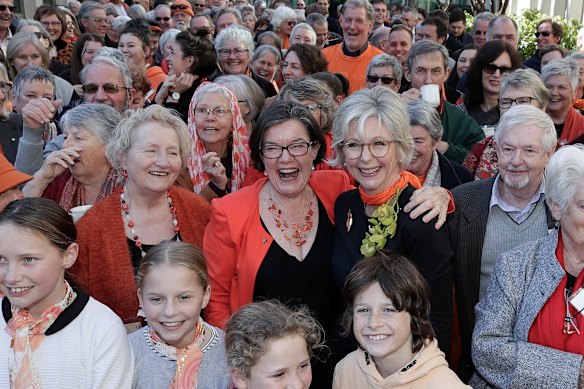
For more than a decade, the former independent MP has helped the people of north-east Victoria do something remarkable. They took politics away from the major parties, put it back into the hands of their communities and helped inspire a movement that changed the face of federal parliament.
On Wednesday evening, standing before hundreds of shaken residents in Wodonga, McGowan confronted the possibility that everything they had built was now under threat. Not from a political opponent nor an election defeat, but from violence.
“There is another level of grief, different and deeper from the actual violence, from the sorrow, the shame and the hurt,” she told the crowd. “It’s about Helen in her role as our elected representative – in attacking her, we intuit that this is an attack on our political system, on our democracy.”
For McGowan, the horror was personal. Helen Haines was not simply her successor in the federal seat of Indi, she was a friend and torchbearer of a political experiment built on the proposition that decent people could disagree without despising one another.
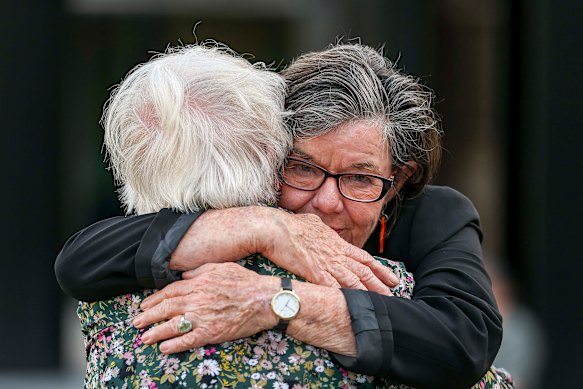
Now Haines was fighting for her life in a Melbourne hospital, both legs amputated following an allegedly deliberate attack outside her Wangaratta electorate office when she was rammed by a LandCruiser as she stood behind her car.
McGowan pondered what sort of nation attacks its politicians. And what sort of democracy emerges from the aftermath.
Australia has arrived at a moment that now feels like a turning point. Whether it becomes one may depend on what happens next.
Late on Monday afternoon, as the horrific details emerged from Wangaratta, private messaging groups used by federal MPs from across the political divide lit up with disbelief. Politicians accustomed to trading insults across the parliamentary chamber were suddenly exchanging messages of anguish.
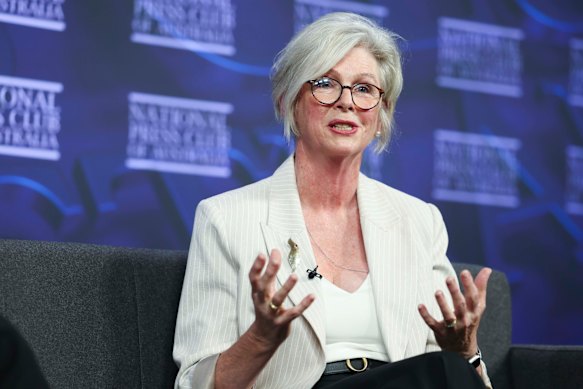
Haines, 65, was among the least polarising figures in federal politics. A former nurse and midwife, she had built a reputation for patient negotiation, integrity and finding common ground.
If someone like Helen Haines could be attacked, who was safe? As the severity of her injuries became clear, the mood in Canberra shifted from shock to something darker.
Senior government and opposition figures moved to reassure anxious colleagues. Security arrangements were reconsidered. Some MPs acknowledged that violent threats had haunted them for years.
The warning signs had been accumulating: the bitter politics of COVID lockdowns; anti-government conspiracies flourishing online; the divisions unleashed by the war in Gaza, including vandals desecrating and lighting a fire at the Melbourne office of Jewish Labor MP Josh Burns; and the antisemitism and communal tensions that culminated in the Bondi terrorist massacre last December.
“For 18 years I’ve joked with school kids that we change governments and the worst injury is a paper-cut on a ballot paper,” Nationals MP Darren Chester said. “It is heart-breaking.”
Home Affairs Minister Tony Burke revealed that authorities had received 1067 reports of harassing and threatening behaviour against high officeholders in the previous financial year – almost three every day. Last year, the Parliamentary Workplace Support Service revealed 85 per cent of surveyed parliamentarians and staff reported dealing with constituents who were behaving in a violent, threatening or volatile manner.
Police have charged Brendan Nugent, 43, from nearby Tarrawingee, over the attack. He made no application for bail when he appeared before Wangaratta Magistrates’ Court on Wednesday. His alleged motivation has not been established.
But that uncertainty does not erase the broader problem confronting Australian democracy. The attack occurred against a backdrop of escalating threats and harassment directed at public officials at every level of government.
Lydia Khalil, a political extremism expert at the Lowy Institute, said violence against an Australian politician had long seemed a matter of “when, not if”. She warns that conspiracy theories, social media and growing anti-institutional sentiment have turned political figures into lightning rods for public anger.
“I’ve been very surprised at how mainstream some of these anti-elite, anti-institutional conspiracy theories have gone,” she said.
Politicians, she argues, are increasingly portrayed not as ordinary Australians entering public life, but as a corrupt, self-serving class divorced from the communities they represent.
That the victim was Haines, “probably the least controversial political figure that you could get”, makes the attack particularly confronting.
Khalil sees hope, however, in the stories of those who rushed to Haines’ aid and the communities rallying around her family: the barber who tackled the driver, the shop assistant who rendered aid, the staff who reassured her.
Australia has known political violence before. In June 1966, then-opposition leader Arthur Calwell was leaving an anti-conscription rally at Sydney’s Mosman Town Hall when a young man approached his car.
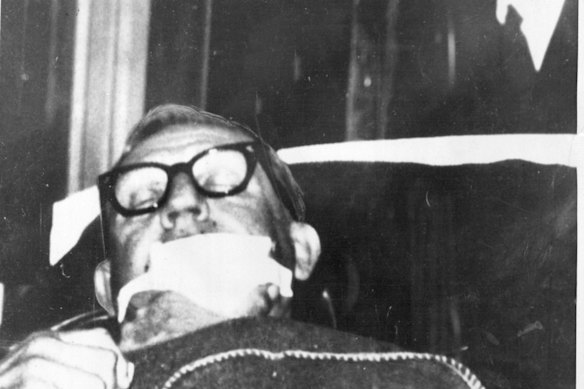
Assuming he was a well-wisher, Calwell began winding down his window. Instead, 19-year-old factory hand Peter Raymond Kocan raised a sawn-off .22 rifle, aimed at his jugular and fired.
The bullet shattered the window, showering Calwell with glass and fragments. Kocan fled but was quickly caught. An isolated young man who wanted to be remembered for killing somebody important, he chose Calwell “because I don’t like his politics”.
Calwell survived, forgave his would-be assassin and sought to have his sentence reduced. Kocan spent a decade in prison before becoming an acclaimed poet.
In 1994, NSW Labor MP John Newman was gunned down outside his Cabramatta home in a killing orchestrated by political rival Phuong Ngo.
But the 21st-century technology has transformed the speed and intensity with which grievance can become obsession. By Tuesday, ASIO Director-General Mike Burgess had issued a warning that read less like a routine security statement than a plea for political sanity.
“While political differences, debates and peaceful protests are essential parts of a healthy democracy, ASIO has seen direct correlations between inflamed language, inflamed tensions and acts of violence,” he said.
“I have repeatedly put on the record my concern about the use of violent rhetoric in public discourse. Words matter.”
Khalil believes social media has accelerated the breakdown of community connections, replacing everyday human interactions with increasingly isolated digital lives.
The disappearance of small encounters at local shops, sporting clubs and community gatherings has weakened social cohesion and made it harder to recognise when vulnerable people are struggling with their mental health or becoming consumed by grievances.
“We’re wired for that connection,” she said, warning that the erosion of those relationships was occurring in both profound and almost imperceptible ways, leaving communities less equipped to identify distress and intervene before it escalates.
Prime Minister Anthony Albanese has acknowledged his own side’s responsibility to lower the political temperature, arguing disagreements should be fought over ideas rather than the motivations of opponents.
One Nation’s Pauline Hanson – under pressure for her cartoon series criticised for distasteful depictions of several MPs – said violence against any elected representative, “whoever they are and whatever they stand for”, was never acceptable. Liberal leader Angus Taylor pleaded for violent attacks to not be normalised.
That test appears mighty. On Wednesday, Australian Federal Police acting Deputy Commissioner Sandra Booth delivered a confronting account of online radicalisation to a parliamentary intelligence committee.
She described a 13-year-old boy allegedly found with plans for a school shooting and vulnerable teenagers manipulated into acts of violence and exploitation through online networks.
Radicalisation and manipulation, once processes taking months or years, could now occur within days.
“Manipulation and the grievances criminals fuel can cause distrust in communities and fray our social fabric,” Booth warned.
Security agencies can investigate threats and prosecute offenders but they cannot manufacture public trust. And, as Khalil said, that trust is showing signs of strain.
Research produced by the McKinnon Foundation, found one in five Australians aged 18 to 24 could not be friends with someone holding different political views. About 9 per cent of Australians believed political violence was sometimes justified.
It exposed a troubling divide in a country where most Australians still favour democracy but only just over half are satisfied with how it works.
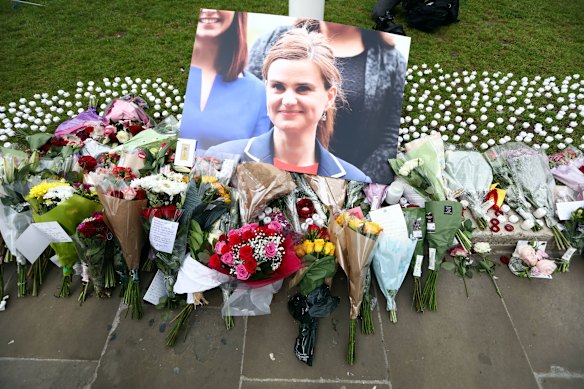
Britain has offered grim warnings. Labour MP Jo Cox was murdered in 2016 while meeting constituents. Conservative MP Sir David Amess was stabbed to death five years later, while this year retired MP Ann Widdecombe was brutally murdered in her rural home.
Kim Leadbeater, Cox’s sister and now a British MP, urged Australians to find common ground.
“This is your moment to think about what your politics looks like and how we can bring people together [and] find common ground,” she said in an interview with the ABC.
University of Canberra political historian Joshua Black said the question was whether this would become a defining moment in Australia’s democratic history.
“If it is a tipping point, there are really serious choices about what sort it will be,” he said.
Black argues Australia’s relative freedom from political violence owes much to a political culture built on “paperwork” rather than revolution, with compulsory and preferential voting helping to keep the political centre intact.
But the rise of social media and an increasingly combative public debate have eroded that advantage.
“I think looking at the global trends, especially what we have seen in the UK, there is cause for concern,” Black says. “The very uneasy political atmosphere for the 10 months since Bondi has been palpable.”
Temptation is to surround politicians with more security and retreat behind managed appearances. But Australia’s democratic strength has always been its accessibility: prime ministers at football matches, ministers in supermarkets, backbenchers at country shows.
Black warned the danger now was that protecting politicians could come at the expense of the accessibility that distinguishes Australian democracy.
Democracy Counts director Tom Mooney says Australia’s democracy only works if decent people were willing to put their hand up to serve their communities by representing them.
He said if this incident is shown to have been politically motivated, it will be an attack on democracy itself.
“We must do more to ensure parliamentarians are safe in their work, and reflect on the culture that is driving dangerously undemocratic behaviour,” he said.
Just before 5pm on Wednesday, outside Melbourne’s Alfred hospital, the enormity of the attack became painfully clear. Phil Haines stepped before the cameras to explain that doctors had been unable to save his wife’s second leg.
But there was something he wanted Australians to understand about his wife. Her heart and mind remained intact. Beside him stood Governor-General Sam Mostyn, who appealed for Australians to relearn how to exercise their “muscle of decency”.
“We don’t have to all agree, but we can wrestle the issue, not the person,” she said.
That evening, hundreds gathered in Wodonga carrying orange cockatoos fashioned from recycled campaign signs. McGowan had another message. She urged them not to retreat.
“My ask … is that we don’t let violence win, that we ensure the legacy of this attack on Helen will be a stronger, more vibrant and effective democracy,” she said.
The question now is whether Australia responds by rediscovering the decency that made that movement possible.
Cut through the noise of federal politics with news, views and expert analysis. Subscribers can sign up to our weekly Inside Politics newsletter.
