On October 14, 1976, the Royal Swedish Academy of Sciences awarded the Prize in Economic Sciences in Memory of Alfred Nobel to Milton Friedman “for his achievements in the fields of consumption analysis, monetary history and theory, and for his demonstration of the complexity of stabilization policy.”
What they were really crediting him for was disproving — and then rewriting — central premises of Keynesian economics.
Keynesian economists believed that macroeconomic problems resulted from a failure of individuals in the aggregate to spend enough money.
Keynesians proposed that the government act as a “spender of last resort.” Keynesian fiscal policy is what undergirds the idea that government should spend “stimulus” money, even if we didn’t actually have it, to increase recipients’ incomes and boost their spending. A “multiplier” would amplify this improvement.
Friedman argued a “permanent income hypothesis” — individuals base their spending decisions not on their current income but on their permanent income. While they might increase their spending consequent to a permanent increase in income, like a pay raise, they would be unlikely to spend more than the face value of a temporary increase like a government stimulus check. He’s largely been proven right.
Keynes also tended to downplay the impact of monetary policy, but Friedman argued it was essential. Government can send people extra money, but unless more goods and services are produced — real output or GDP — that money will only cause prices to rise: demand-pull inflation.
In fact, nominal spending increases can distort real output even if prices don’t change much in the short term. When stimulus-rich consumers ask for more of something, businesses produce more, only to learn when prices have adjusted that they must cut back again.
The quantity of money demanded can change, which is reflected in changes in its velocity of circulation (V) but generally, these changes cancel each other out. The relentless increase in prices (P) can only be explained by the remorseless increase of M (money supply), Friedman argued.
Friedman found empirical support for this in his 1963 book A Monetary History of the United States, 1867-1960, written with Anna Schwartz. In it, they explored how deliberate monetary contraction during the Great Depression turned a downturn into a catastrophe. They found that people’s demand for money was reasonably stable, or changed only in gradual and predictable ways. This stability of money demand means that, in the long run, changes in M manifested themselves in changes in P, captured in the famous equation:
MV = Py
Friedman put this on his license plate.
Keynesian economics was aimed at a single goal: maintaining a high level of employment. The “Phillips Curve” became the tool to measure if it was working.
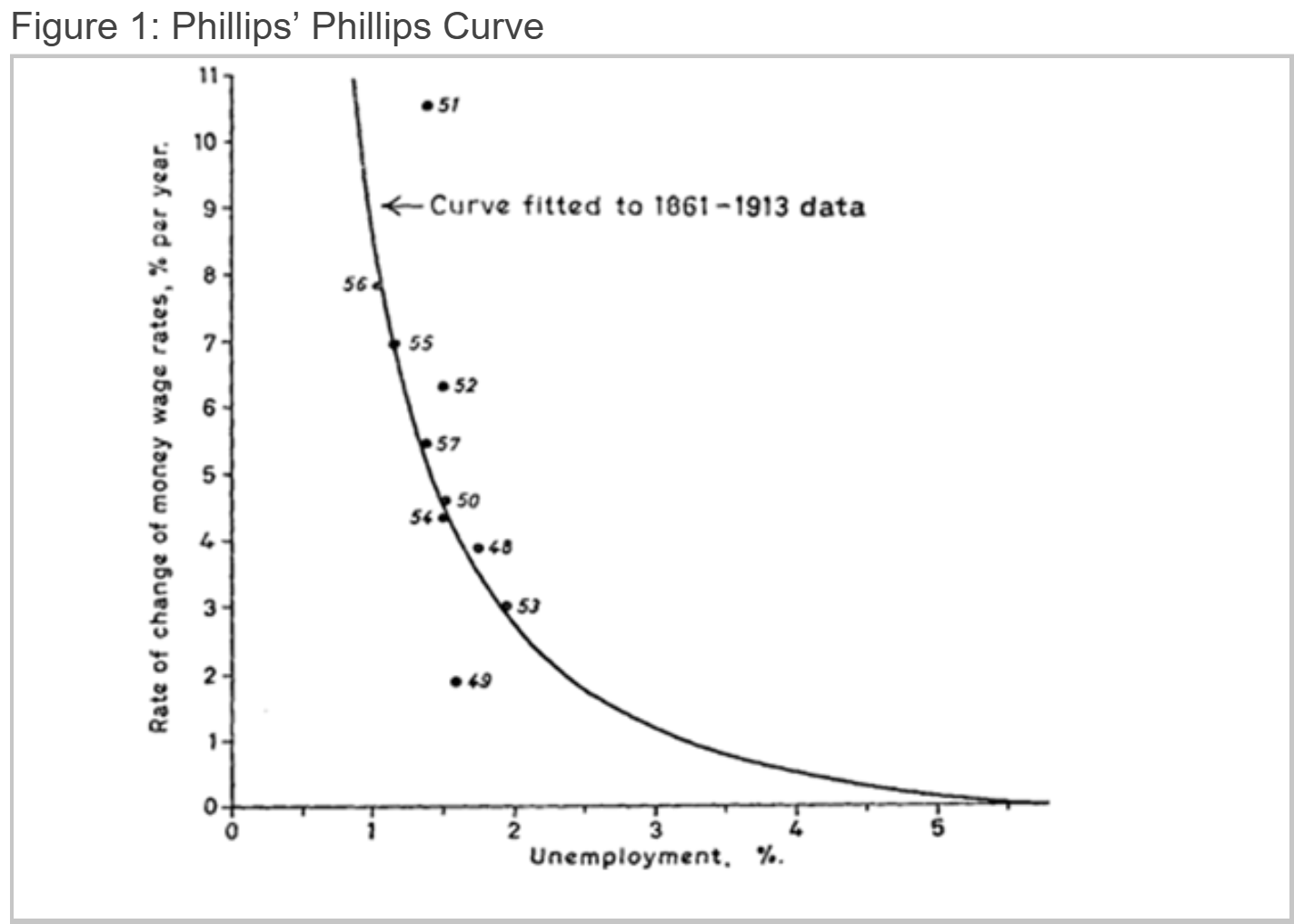
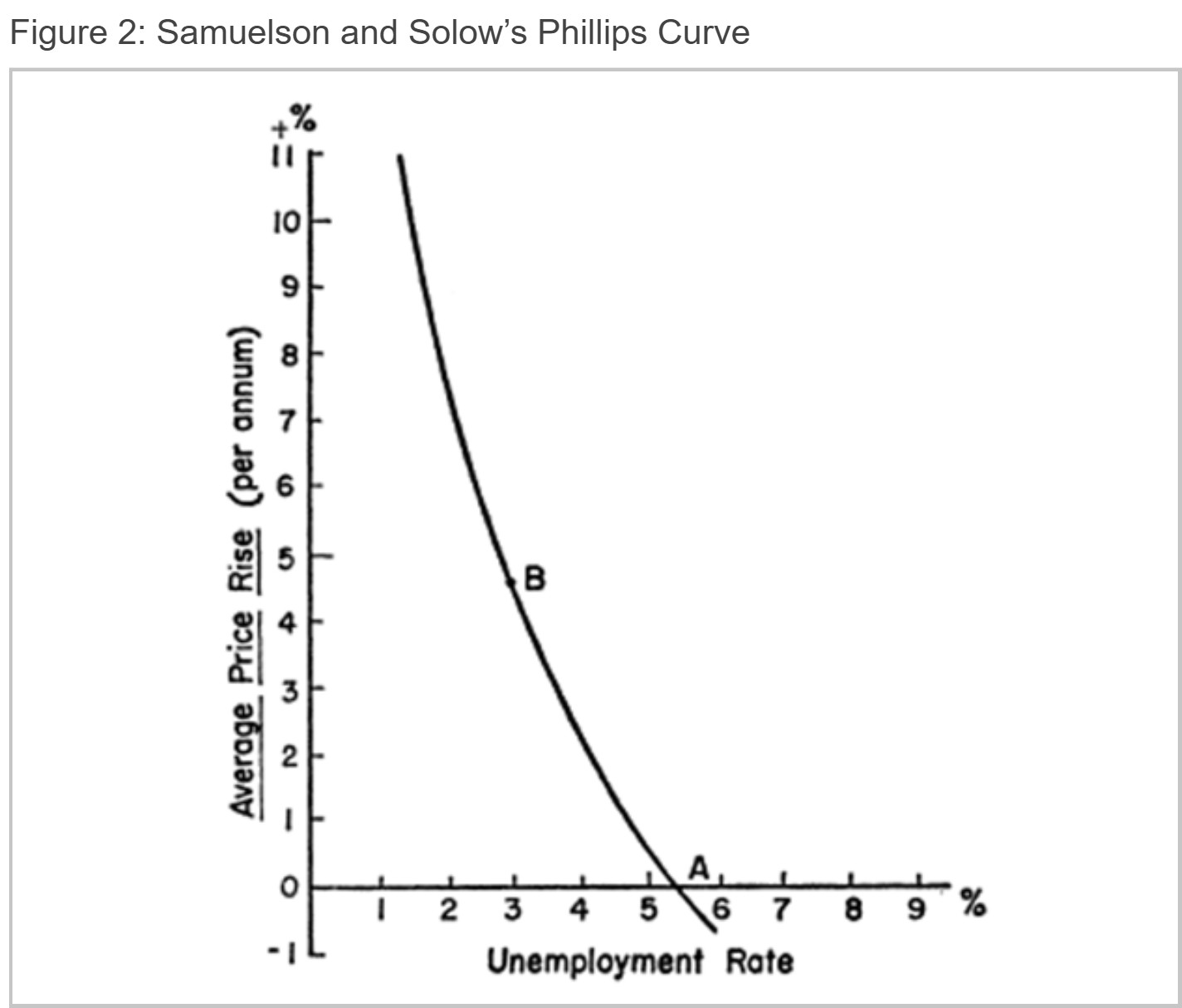
In 1958, the economist A.W. Phillips sifted through a century of British data and discovered a relation between unemployment and the “rate of change of money wage rates” (Figure 1: Phillips’ Phillips Curve). In 1960, economists Paul Samuelson and Robert Solow replaced the “rate of change of money wage rates” with “Average Price Rise” (Figure 2: Samuelson and Solow’s Phillips Curve) and an apparent tool for macroeconomic management was born. The lever was essentially this: lower unemployment could be bought with higher inflation.
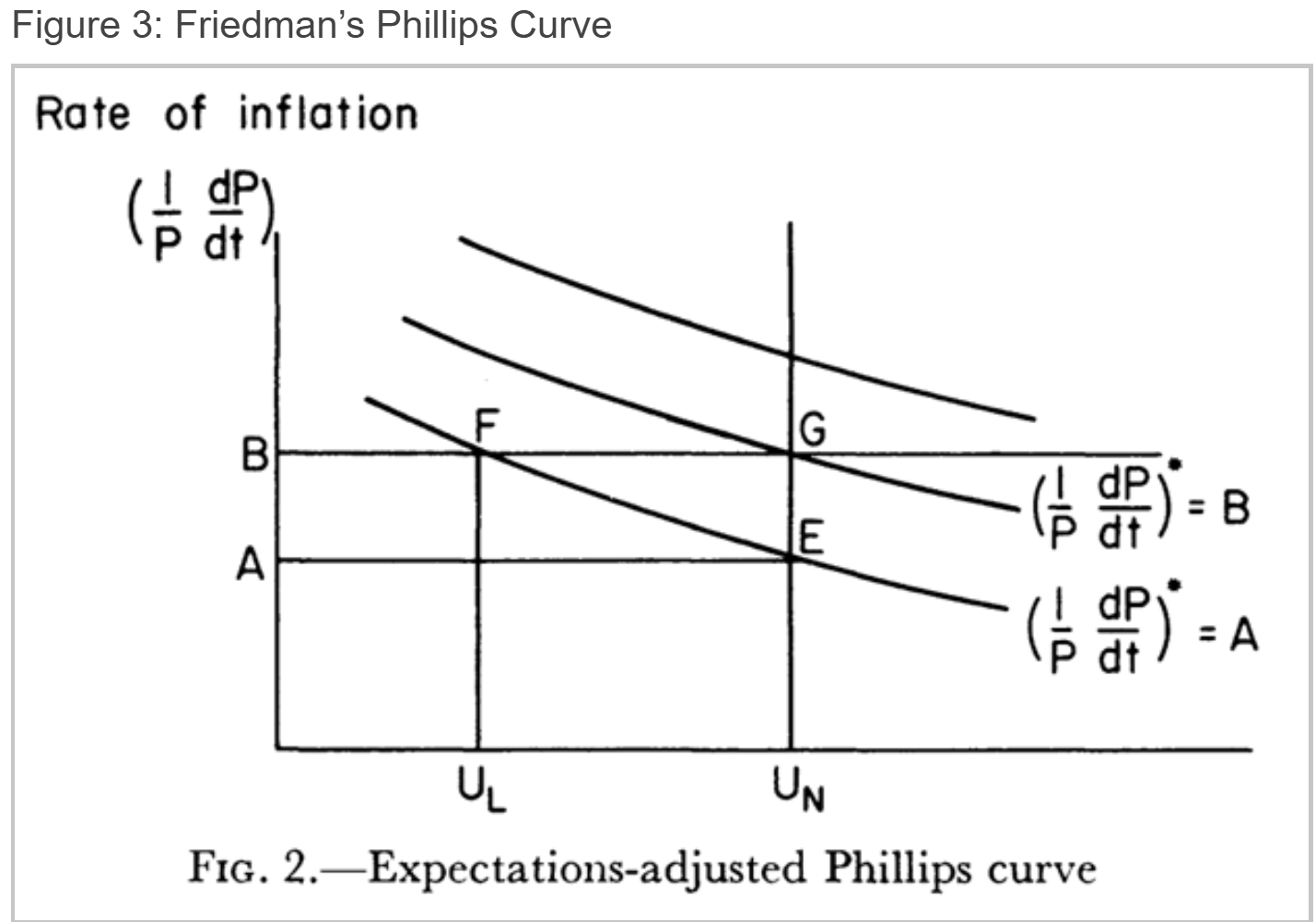
At the Curve’s heyday as a policy tool in 1968, Friedman argued that it “contains a basic defect,” the failure to distinguish between nominal and real changes. His analysis of money demand had shown that an inflationary monetary policy could succeed at reducing unemployment in the short run by, in effect, fooling producers. If they expected inflation, they would simply raise prices and output would be unaffected. Only unexpected inflation could generate increases in output. As soon as this became expected, only a new, unexpected, higher rate of inflation would suffice. Not only could inflation and unemployment rise together, Friedman argued, they might do so at increasing rates (Figure 3: Friedman’s Phillips Curve).
Friedman was soon proved right. The inflation rate rose from 1.6 percent in 1965 to 5.9 percent in 1970 and unemployment rose too, from 3.5 percent in 1969 to 6.0 percent in 1971. As the Nobel committee considered the candidates for 1976, the Phillips Curve drifted northeast. Inflation and unemployment rose together, and a previously obscure portmanteau gained traction everywhere: stagflation. By the end of the decade, the Curve was abandoned as a policy tool (Figure 4: The actual Phillips Curve).
Friedman’s permanent income hypothesis challenged Keynesian fiscal policy, while his theory of the demand for money challenged Keynesian monetary policy and helped explain how monetary mismanagement could deepen and prolong recessions. Even if Friedman’s suggested policies of money supply control were rarely implemented, his focus on monetary stability as a prerequisite for sustained economic growth underpinned nearly three decades of low inflation and economic growth. Central bankers now know that expectations matter, and that sustained inflation is a monetary-policy concern. The Great Moderation, growth from the mid-1980s to 2007, was The Age of Milton Friedman.