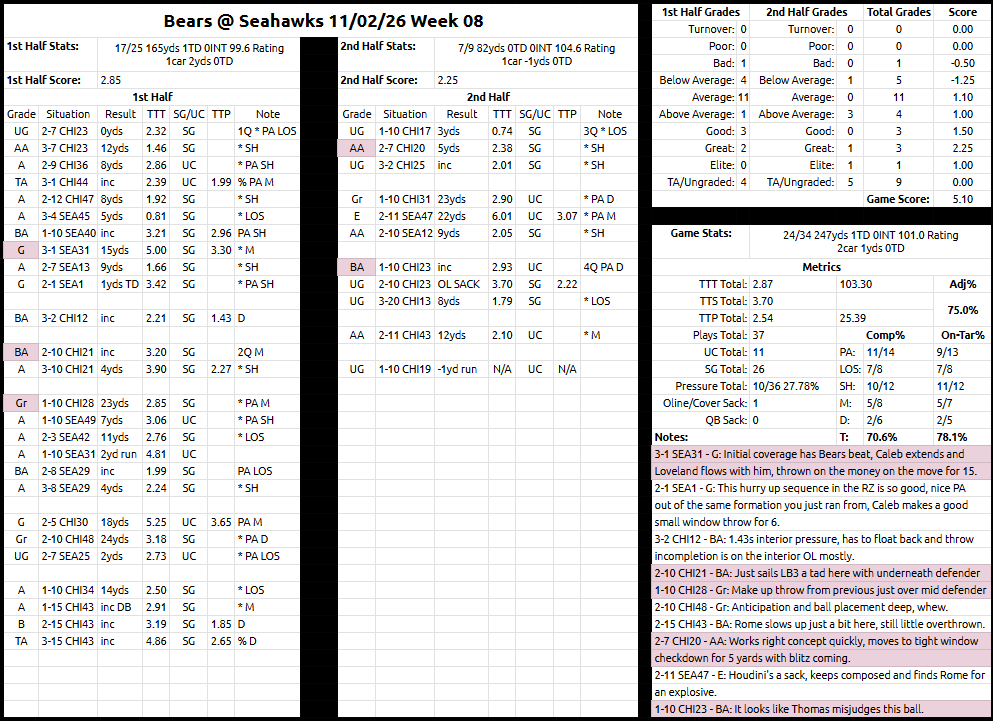
Note: Before kicking things off this week, just a just note. Play breakdowns wont be available this week due to traveling for work, these will continue for week 9. In their stead I added some more interesting data points and nuggets to fill out this weeks’ breakdown.
If last week was about Caleb Williams showing he could attack a defense in just about any way it presented itself, Week 8 was about proving he could do it against one of the best units in football.
Advertisement
Seattle entered Monday night with the NFL’s No. 1 defense, allowing just 144.4 passing yards per game. No quarterback had reached 200 yards against them all season, and the Seahawks hadn’t allowed more than 301 total yards in any of their first seven games. Justin Herbert couldn’t do it. Brock Purdy couldn’t do it. Patrick Mahomes couldn’t do it.
Williams did.
On the road. In primetime. At Lumen Field. Against the defending Super Bowl champions.
If we’re weighing opponent, environment and situation, this might have been the most impressive performance Williams has put on tape this season.
Advertisement
He completed 24 of 34 passes for 247 yards, one touchdown and no interceptions, finishing with a 101.0 passer rating as Chicago walked out of Seattle with a 34-17 win. Williams became the first quarterback to crack 200 passing yards against the Seahawks this season, while the Bears finished with 363 total yards against a defense that had entered the week allowing fewer than 302 in every game.
The tone was set immediately.
After Chicago’s defense opened the game with a three-and-out, Williams took the offense on a 17-play, 80-yard touchdown drive that burned 8:32 off the clock. He completed eight of 10 passes on the possession before extending a second down play and finding Luther Burden III for the opening score.
Seattle hadn’t allowed an opening-drive touchdown in 16 games, and opponents had gone 17 consecutive possessions without even reaching the Seahawks’ red zone.
Advertisement
Chicago broke both streaks on its first opportunity, and like they have done so much this season already, never looked back.
That opening possession ended up being a pretty good preview of how the rest of the night would go. The Bears weren’t necessarily explosive on every drive, but they remained patient, stayed on schedule and made Seattle’s defense work for everything. Chicago finished with 70 offensive plays and held the football for 35:03, continuing a season-long trend of controlling games through sustained possessions. Bill Zimmerman highlighted just how dominant that time-of-possession battle has become over the season.
The broader offensive results when Williams has been able to play a full game have been just as encouraging, which is becoming harder to dismiss as a small-sample fluke with each passing week.
And this wasn’t a Seattle defense suddenly playing poorly before Chicago arrived.
Advertisement
According to SumerSports, Seattle had not allowed positive offensive EPA in a single game all season. The Bears became just the fourth team since the start of 2025 to generate positive EPA against Mike Macdonald’s defense.
That’s important context when looking at Williams’ raw stat line.
247 yards and one touchdown probably isn’t going to jump off the page after back-to-back 300-yard games, but this was never going to be the type of matchup where the numbers told the entire story. Seattle’s defense is designed to affect the quarterback with four rushers, keep bodies in coverage and force an offense to string together long possessions without making mistakes.
Williams largely did exactly that.
Advertisement
He continued to play efficient football even in obvious passing situations, something George Hatzadony’s charting has consistently highlighted this season, while also showing the same ability to create when Seattle disrupted the pocket.
That second part continues to be one of the more encouraging developments of his season.
Williams has always had the physical ability to escape pressure. The difference now is that more of those plays are ending with productive decisions rather than simply becoming extended chaos or balls that end up thrown away. PFN noted this week that Williams is one of only four qualifying quarterbacks producing positive EPA under pressure this season, joining Josh Allen, Patrick Mahomes and Drake Maye.
There were several examples Monday night where Williams escaped the initial rush, reset and still delivered an accurate football rather than immediately abandoning the structure of the play.
Advertisement
That balance has become increasingly noticeable. The highlight-reel improvisation is still there, but it isn’t replacing the offense anymore. It’s supplementing it.
You could see that especially when Williams began attacking Rome Odunze after halftime. Odunze finished with four catches for 87 yards, with gains of 23 and 22 yards helping set up Chicago’s third-quarter touchdown. Williams consistently attacked the intermediate areas of Seattle’s coverage, an area where the Seahawks had been one of the league’s better defenses entering the game.
And when Seattle finally made its push in the fourth quarter, Chicago answered.
A Colston Loveland fumble gave the Seahawks a short field and allowed them to cut the lead to 20-17. Lumen Field suddenly sounded like Lumen Field again, and for the first time all night it felt like momentum had completely shifted.
Advertisement
The Bears responded with a six-play, 56-yard touchdown drive.
The biggest play came on third-and-9 when Williams got the football quickly to Kalif Raymond, who split the defense for 39 yards on what was officially a run play. D’Andre Swift finished the drive with his second touchdown.
That’s another area where this team continues to look different.
Chicago isn’t simply surviving close games anymore. When opponents have made their push, the Bears have increasingly answered by taking control right back.
The 17-point victory was Seattle’s first loss by more than four points in 30 games, including the postseason. Their previous six losses dating back to the start of the 2025 season had come by 17 combined points.
Advertisement
Chicago beat them by 17 in one night.
Williams also quietly added another piece of NFL history. Monday marked his 36th consecutive regular-season game with at least 20 pass attempts and no more than one interception, breaking Aaron Rodgers’ previous record of 35.
He also became the first quarterback in Bears history to lead the offense to 30-plus points in three consecutive games without committing a turnover, another sign of how consistently clean his football has become.
Tom Brady even called Williams the “perfect quarterback” for Ben Johnson’s offense, praising the way Johnson uses Williams’ skill set within an offense that can attack defenses through the run game, quick passing, explosives, screens and misdirection.
Advertisement
That’s really what the last three weeks have shown.
Atlanta tried to keep everything underneath, so Williams patiently took the completions.
New England brought pressure and gave him opportunities downfield, so he punished them with eight explosive completions.
Seattle brought the league’s best defense into one of the toughest environments in football and dared Chicago to methodically work its way down the field.
Williams did that too.
The Bears have now scored at least 30 points in three straight games since his return, and they haven’t trailed for a single second during that stretch.
Oh, and Chicago just became the first team in NFL history to beat both participants from the previous Super Bowl in back-to-back primetime games.
Advertisement
Patriots on Thursday night.
Defending champion Seahawks in Seattle on Monday night.
Two wins.
If you wanted a stretch that starts making people view this team a little differently, that’s probably it.
Now let’s get into the numbers.
(Season totals are underlined, Season Averages in Italics, and this week’s stats appear in regular text.)
C/A: 88/124 (71.0%) | 22/31 (71.0%) | 24/34 70.6%
Yards: 1020 | 255 | 247
Touchdowns:6 | 1.5 | 1
Turnovers: 1| 0.3 | 0
QB at Fault Sacks: 1 |0.3 | 0
aDOT: 6.6 | 9.4
Passer Rating: 105.6 | 101.0
True Passer Rating: 119.1 | 139.7
Time to Throw: 3.23s | 2.87s
Advertisement
Time to Pressure: 2.55s | 2.54s
Pressure Rate: 38.87% | 27.78%
On-Target Rate: 88.0% | 78.1%
Poor Play Rate / Big Play Rate: 3.5% PPR /7.6% BRP | 0.0% PPR /10.8% BRP
EPA per dropback: +0.28 | +0.40
ANY/A: 7.3 | 9.1

The full grading sheet for each play can be found here.
Note: Last year, I included PFF grades in these breakdowns. With PFF continuing to expand its use of AI across its platform, and with my confidence in how accurately its grades reflect quarterback performance declining, I’ve decided to move away from them this season. In their place, I’ll be using PFN’s Impact Score, which will be notated as PFN on grading sheets moving forward.
Advertisement
NFL Passer Rating / True Passer Rating / PFN Impact Score: 101.0 / 139.7 / 78.0
-
The NFL’s average passer rating through Week 8 sits at 91.5, putting Williams’ 101.0 against Seattle comfortably above average.
-
Four of Williams’ five starts have now produced a passer rating north of 100. He reached that mark just five times across the entire 2025 season, another one of the many markers of growth we’ve seen so far.
-
-
A 139.7 TPR represents a great outing, built once again around measured aggression without putting the football in harm’s way.
-
Williams’ 9.4 aDOT was his highest since Week 1, which makes the performance even more impressive considering the quality of the defense he was facing.
-
-
On the PFN scale, where 75 represents an average qualifying starter and 90 is elite territory, Williams finished Week 8 with a 78.0 Impact Score, ranking 10th among qualifying quarterbacks.
On-Target Throws: 2026 Average: 84.9% | Week 8: 78.1%
-
Reminder: Completion percentage ≠ On-Target Percentage. I only chart aimed passes, meaning throwaways, spikes and passes deflected at the line are excluded. Drops can still be credited as on-target.
-
Short-Level Passing (Behind LOS–9 yards): 18/20 | 90.0% On-Target
-
Deep-Level Passing (10+ Yards Downfield): 7/12 | 58.3% On-Target
-
Williams remained deadly accurate underneath, missing on just two short-level throws all night.
-
There were a few misses farther downfield that I’m not particularly concerned about. One deep shot to Rome Odunze late in the first half came with the pocket collapsing, while another pressure-affected throw sailed harmlessly out of bounds. The high miss to Zavion Thomas was more notable for a few reasons, and we’ll break that one down later.
-
Poor Play Rate / Big Play Rate: 0.0% PPR / 10.8% BPR
-
Williams now sits at roughly a 2.9% Poor Play Rate and 8.2% Big Play Rate on the season.
-
What might be the most impressive part of his Seattle performance is that Williams didn’t record a single “Poor” or turnover-worthy play against one of the league’s best defenses.
-
At the same time, he posted a 10.8% Big Play Rate with three “Great” plays and one “Elite.”
-
The “Great” throws included a beautifully layered ball over the middle to Luther Burden III, the 23-yard dig to Rome Odunze following the direct snap to D’Andre Swift, and another anticipatory dig to Odunze for an explosive gain.
-
His lone “Elite” play came after escaping what looked like a sure sack, regaining his composure and firing a dart downfield to Odunze for another 22 yards.
-
-
EPA per Dropback: 2026 Average: +0.28 | Week 8: +0.14
-
Williams’ +0.14 EPA/dropback was about half his season average, but the opponent matters quite a bit here. Seattle entered Week 8 having not allowed positive offensive EPA in a single game all season.
-
A fun little nugget within the larger EPA conversation: Williams has been lethal on third down this season, leading the league in third-down EPA according to this charting.
-
EPA isn’t everything, but continuing to produce positive efficiency against a defense that had largely erased opposing offenses all season is another point in Williams’ favor.
-
ANY/A: 2026 Average: 7.3 | Week 8: 7.3
-
Williams landed directly on his season average with a 7.3 ANY/A against Seattle. The 2026 league average currently sits at 6.2.
-
Doing that against this particular defense adds some important context. Seattle entered Week 8 allowing just 3.5 ANY/A to opposing passers.
-
Williams more than doubled that number, on the road, in one of the league’s toughest environments. That’s an exceptional performance relative to the matchup.
-
Time to Throw: 2026 Average: 3.16s | Week 8: 2.87s
-
For the first time this season, Williams finished under three seconds in my Time to Throw charting, averaging 2.87 seconds across 36 dropbacks.
-
When Chicago wasn’t looking to exploit a matchup downfield, the offense was content to use quick-hitting routes underneath to neutralize Seattle’s front four.
-
It worked. Williams was sacked just once, while my charting had Seattle generating pressure on a season-low 27.78% of his dropbacks.
-
Hurry Up!
-
One of my favorite follows on Twitter breaks this down better than I ever could, but Chicago shifted into hurry-up twice in goal-to-go situations to prevent Seattle from substituting and force the defense to remain in favorable personnel.
-
Both situations came from essentially the same formation, with Ben Johnson adding a different wrinkle the second time around.
-
It’s another example of the extra layer Johnson brings to the offense, but just as importantly, it shows how comfortable this group has become executing those adjustments on the fly.
-
Williams finishes Week 8 with final grades of 1st Half (2.85) / 2nd Half (2.25) / Game (5.10), with the snap threshold adjustment bumping his final score to 5.30. This scores solidly as a “Good” outing, his fourth in five starts.
It doesn’t quite reach the 6.30 grades he posted against Carolina and New England, but considering the circumstances, I think there’s a strong argument this was his most impressive performance of the season.
Advertisement
Seattle entered Monday night with the best defense in football, hadn’t allowed a 200-yard passer all season and had consistently made life miserable for opposing quarterbacks. Williams walked into one of the league’s toughest environments in primetime, against the defending Super Bowl champions, and never really looked overwhelmed by any of it. He didn’t have to play superhero ball either. Chicago stayed patient, kept the offense on schedule and consistently found answers when Seattle tried to change the picture.
That’s reflected in the grading as much as anything else. Williams didn’t register a single “Poor” or turnover-worthy play while still producing four “Great” or “Elite” plays. He finished with a 10.8% Big Play Rate, pushed his aDOT back up to 9.4 yards and still managed to play clean football against a defense that had entered the week suffocating opposing passing games.
The stat line probably won’t be remembered the same way as the back-to-back 300-yard performances that preceded it, but I don’t think it needs to be. This was another example of Williams showing he can win in a different way depending on what the defense demands from him. His ability to keep the offense on schedule cannot be overstated, the Bears averaged just 3.6 yards per rush, while D’Andre Swift averaged 2.6, but Caleb’s ability to move the ball allowed Swift 3 rushing touchdowns, putting him in the league lead with 10 on the year.
Of the six quarterbacks I’m grading this season, Williams finished 1st of the five who played in Week 8. You can see where his performance landed among the group here.
Advertisement
For a look at how the entire group stacks up on the season, along with some quick notes on this week’s performances, you can find that here.
The Bears now return home at 6-2 for another primetime matchup, this time against Tampa Bay on Sunday Night Football. The Buccaneers may only be 3-5, but they’re suddenly playing considerably better football after consecutive wins over Carolina and Atlanta. Tampa just shut out the Falcons 16-0 while running for a franchise-record 324 yards, so this isn’t exactly a matchup Chicago can sleepwalk through.
Three straight wins since his return, three straight games with at least 30 points and another strong grade against the best defense he’s faced all season.
Not a bad way to keep this thing rolling.
Advertisement
Until next time, Bear Down!
Gary Baugher Jr. is a second year contributor to WCG, bringing football insight backed by over 16 years of experience in organized football and more than 30 years as a passionate fan of the game. You can follow him on Twitter at @iamcogs.